The State of German Manufacturing Market Research Report
1. Industry Overview & Executive Summary
Size, CAGR, macro outlook
Germany is still an industrial heavyweight by any European standard. In 2024, manufacturing produced 19.9% of Germany’s gross value added, compared with an EU average of 15.9%. France sat at 10.7% and Spain at 11.9%, which shows how structurally “manufacturing-forward” Germany remains. (destatis.de)
Now the mood check.
The near-term picture is basically: less bad, not booming.
- The HCOB Germany Manufacturing PMI improved from 47.0 in December 2025 to 48.7 in January (Trading Economics). That’s still below 50, meaning the sector is in mild contraction territory rather than clear expansion. (Trading Economics)
- The PMI release for December also flagged weakening conditions and declining output, with the headline PMI falling from 48.2 in November to 47.0 in December. (pmi.spglobal.com)
If you’re writing an exec summary in plain English: Germany’s manufacturing engine is idling. It’s not stalling, but it’s not revving either.
Key drivers of industry growth
Here’s what’s pushing and pulling the sector right now, with a deliberately practical lens.
- Structural strength: deep industrial base
Germany’s manufacturing share isn’t a rounding error. It’s a core economic pillar, and it creates dense supplier ecosystems, talent pools, and export capability that are hard to replicate quickly elsewhere. (destatis.de) - Labor constraint: a quiet handbrake on growth
Even in a softer economy, skilled labor is still tight. The ifo Institute reported 28.3% of companies say they have too few qualified workers (down from 31.9% earlier, but still a lot). The key nuance is in the ifo commentary: the slowdown dampens demand for talent temporarily, but demographics keep the long-term pressure on. (ifo Institut) - Supply chain redesign: resilience over pure cost
Nearshoring isn’t just a talking point. fDi Intelligence (using fDi Markets) reports more than $82bn pledged to manufacturing projects in 15 nearshoring destinations across Central/Eastern Europe and North Africa during 2022–2023, the highest two-year figure on record and +62% vs 2018–2019. This affects Germany directly because it reshapes supplier footprints, lead times, and where “capacity buffers” sit. (fdiintelligence.com) - Cycle reality: demand remains cautious
PMI data suggests manufacturers are still navigating weak demand, with the index below the 50 threshold. When that happens, leadership teams focus on protecting margin, tightening inventory, and defending core customers rather than chasing aggressive expansion. (Trading Economics, pmi.spglobal.com)
Cross-functional summary: financial, marketing, ops
Financial pulse (what matters most right now)
- Working capital discipline is a front-line KPI in slower demand periods: inventories, supplier terms, and order book quality matter as much as revenue growth.
- The PMI downcycle signals a familiar playbook: conservative hiring, cautious capex, and “prove ROI fast” thresholds for new projects. (Trading Economics, pmi.spglobal.com)
Marketing pulse (what’s different vs five years ago)
- The buyer is more research-led and less patient. In industrial categories, that usually translates to heavier investment in product documentation, self-serve technical content, and faster quotation workflows (so the customer doesn’t have to beg for basic clarity).
- Messaging that tends to work right now: risk reduction (uptime, lead times, compliance) and measurable cost savings (energy, scrap, maintenance hours). This aligns with the current operational pressures: labor shortages plus cost volatility. (ifo Institut, Trading Economics)
Operations pulse (where execution either saves you or hurts you)
- Supply chain strategy is actively being redesigned around regional resilience. Nearshoring flows into nearby regions suggest manufacturers are building “Plan B capacity” closer to home. (fdiintelligence.com)
- Workforce constraints make automation and process standardization less optional. Even if demand is soft today, the demographic issue doesn’t politely go away. (ifo Institut)
Industry Snapshot Table
| Signal | What it tells you | Latest read | Source |
|---|---|---|---|
| Manufacturing share of gross value added | Germany’s economy is structurally industry-heavy | 19.9% (Germany, 2024) vs 15.9% EU avg | Destatis (Eurostat) |
| Manufacturing PMI | Direction of business conditions | 48.7 (Jan 2026) vs 47.0 (Dec 2025) | Trading Economics (HCOB/S&P Global PMI) |
| Skilled labor shortage | Capacity constraint even in slower growth | 28.3% of firms report too few qualified workers | ifo Institute |
| Nearshoring investment | Supply chain footprint shift near Europe | >$82bn pledged (2022–2023) | fDi Intelligence (fDi Markets) |
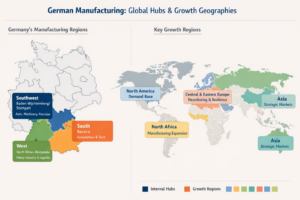
Global Hubs or Growth Geographies Map
2. Finance & Investment Landscape
German manufacturing finance right now feels a bit like walking through a factory at shift change. Things are moving, deals are happening, but everyone is paying closer attention to costs, timing, and what actually adds value.
The era of “growth at any price” is gone. This is a period of selective capital, strategic reshaping, and a clear bias toward resilience.
Recent M&A activity (deal volume, major acquirers)
M&A in German manufacturing has not disappeared, but it has become more intentional.
The big themes behind recent transactions:
- Portfolio cleanup: large industrial groups selling assets to strengthen balance sheets or focus on core segments
- Capability buying: strategic acquirers targeting software, simulation, automation, and electrification-related assets
- Mobility transition pressure: suppliers divesting pieces tied to the auto industry’s technology shift
PwC’s Germany-focused M&A update notes that Industrials & Services deal activity in the first half of 2025 remained relatively stable (down only 2% vs H1 2024), with Industrial Manufacturing and Business Services representing about two-thirds of deal volume. (pwc.de)
That’s an important point: the deal machine is still running, just with tighter filters.
Deal Table
| Buyer | Seller / Target | Asset | Announced | Deal Value | Strategic Angle | Source |
|---|---|---|---|---|---|---|
| Carlyle + QIA-backed funds | BASF | BASF Coatings business | Oct 2025 | €7.7bn enterprise value | BASF raises capital and sharpens portfolio focus; buyer acquires a stable industrial cash-flow platform. | BASF press release |
| Siemens | Altair Engineering | Simulation + industrial software leader | Completed 2025 | ~USD 10bn enterprise value | Deepens Siemens’ digital twin and industrial AI stack. | Siemens release (PDF) |
| Harman (Samsung subsidiary) | ZF | Advanced Driver Assistance Systems (ADAS) business | Dec 2025 | €1.5bn enterprise value | ZF reduces complexity and frees resources; Harman expands its automotive electronics footprint. | ZF press release (PDF) |
The takeaway is pretty clear: industrial manufacturing is buying the future (software, simulation, electrification), while selling parts of the past (legacy-heavy, capital-intensive segments).
Investment trends (PE/VC rounds, IPOs, dry powder)
Private equity remains active in German industrials, but the focus has shifted.
Instead of broad roll-ups, investors are prioritizing:
- Industrial software adjacency
- Recurring aftermarket/service-heavy models
- Assets with pricing power and defensible niche positions
- Operational improvement plays (automation, lean, procurement)
KPMG’s 2025 M&A trends reporting highlights that even when deal volumes soften, deal value can remain supported by strategic buyers and larger capability-driven transactions. (kpmg.com)
Meanwhile, IPO markets for traditional manufacturers remain muted compared with 2021 peaks, as higher rates and macro uncertainty keep valuation expectations grounded.
Revenue models & unit economics (LTV, CAC, margins)
Manufacturing is not a pure SaaS world, but the best German industrial businesses increasingly borrow SaaS-like economics through services.
The modern revenue mix often looks like:
- Equipment sale (lower margin, cyclical)
- Spare parts + consumables (high margin, sticky)
- Service contracts (recurring, predictable)
- Software layers (scalable margin potential)
McKinsey provides one of the cleanest benchmarks here:
- Aftermarket services average EBIT margins of ~25%
- New equipment averages closer to ~10%
That spread explains why so many German OEMs are racing toward service-based models and lifecycle revenue. (mckinsey.com)
Practical unit economics lens for industrial firms
Instead of pure LTV:CAC, manufacturers often track:
- Installed base expansion rate
- Service attach rate (%)
- Renewal and contract duration
- Cost-to-serve per customer site
- Spare parts fill rate
Still, for recurring-service models, an LTV:CAC ratio around 3:1 is often treated as a healthy benchmark in B2B subscription businesses. (growth-onomics.com)
LTV:CAC Ratio Chart
| LTV:CAC Ratio | Category | What it Usually Means | Practical Interpretation (German Manufacturing Context) |
|---|---|---|---|
| < 2x | Poor / Unsustainable | Customer acquisition is too expensive relative to lifetime value. Growth may destroy profitability. |
Common in low-margin equipment sales without service contracts or repeat revenue. |
| 2x – 3x | Below Average | Unit economics are workable but fragile. Retention or pricing improvements are needed. |
Seen in competitive industrial segments with weak differentiation or limited aftermarket capture. |
| ~3x | Healthy Benchmark | A widely used target for sustainable B2B growth. Enough return to reinvest while staying profitable. |
Typical for manufacturers with strong service attach rates and recurring maintenance revenue. |
| 4x – 5x | Strong | Very efficient customer acquisition and high customer lifetime value. Indicates pricing power or strong retention. |
Often achieved by firms selling mission-critical systems with long-term service agreements. |
| > 5x | Very Strong (or Under-Investing) | Exceptional unit economics, but may also signal the company is spending too little on growth. | Common in niche “hidden champions” with locked-in industrial customers and high switching costs. |
Financial health indicators (burn rate, runway, profitability)
Traditional manufacturers don’t talk about “burn rate” the way startups do, but financial health is still under pressure from:
- Demand softness
- Energy and input cost volatility
- Workforce constraints
- Capex needs for automation and decarbonization
Key indicators executives are watching closely:
- Order stock and backlog quality
Destatis reported that the real stock of orders in manufacturing rose 0.6% in September 2025 vs August, and was up 4.1% year-over-year. (destatis.de) - Margin compression signals
PMI commentary highlights rising input costs even as selling prices remain pressured, a classic squeeze scenario (tradingeconomics.com) - Capital allocation discipline
Companies are prioritizing:
- automation ROI
- service-margin expansion
- selective divestitures
- digital capability acquisitions
EV/Revenue and EV/EBITDA Multiples
| Manufacturing Segment | Typical EV/Revenue Multiple | Typical EV/EBITDA Multiple | Notes (Why it trades this way) |
|---|---|---|---|
| Traditional industrial manufacturing (machinery, components) | 0.8x – 1.8x | 6x – 10x | Cyclical demand, capex-heavy, margins depend heavily on the order cycle |
| Diversified industrial OEMs with strong service mix | 1.5x – 3.0x | 8x – 14x | Aftermarket and recurring services stabilize cash flows and improve visibility |
| Automotive suppliers (hardware-heavy) | 0.5x – 1.5x | 5x – 9x | Transition pressure (EV shift), pricing compression, high competition |
| Chemicals and basic materials | 0.6x – 1.5x | 5x – 9x | Energy sensitivity, global overcapacity risk, and margin volatility |
| Industrial automation and electrification leaders | 2.5x – 5.0x | 12x – 20x | Higher growth, software adjacency, stronger pricing power |
| Industrial software and simulation (manufacturing tech layer) | 5.0x – 10.0x+ | 18x – 30x+ | Asset-light, recurring revenue, higher gross margins, strategic scarcity value |
3. Marketing Performance & Trends
German manufacturing marketing is having a personality shift. It still loves a good trade fair handshake, but buyers are also quietly saying: “Let me research in peace. If I need you, I’ll call.”
Channel breakdown: SEO, paid, influencer, email, events
The channel mix in manufacturing is unusually hybrid. You rarely win with a single channel. What works is a connected system where each channel plays a specific role.
Here’s the clearest survey snapshot I’ve found that maps well onto industrial go-to-market:
- Top areas of B2B marketing spend for 2025 include marketing technology (54%), direct marketing (36%), content marketing (34%), branding (29%), and tradeshows and events (21%). (Sagefrog Marketing Group, LLC)
- Top lead sources in the same survey: in-person tradeshows and events (45%), virtual events and webinars (35%), direct marketing (29%), email marketing (29%), and then a cluster of directories/sponsorships, paid social, referrals, SEM, and organic search. (Sagefrog Marketing Group, LLC)
That blend basically screams: “We still meet people in real life, but we nurture and close with systems.”
Buyer behavior trends (demographics, psychographics, decision triggers)
- Rep-free is the new default mood
Gartner found 61% of B2B buyers prefer an overall rep-free buying experience. The point is not “sales is dead.” The point is buyers want control early, and they want seller involvement later, on their terms. (Gartner)
What that means in German manufacturing:
- If your website hides pricing logic, specs, lead times, and integration details, buyers don’t feel “premium.” They feel blocked.
- The first vendor to make comparison easy often makes the shortlist.
- Big-ticket digital buying is no longer weird
McKinsey’s 2024 B2B Pulse work describes a “rule of thirds” pattern: buyers split their preferred interaction modes across in-person, remote, and self-serve in a surprisingly consistent way, and comfort with remote and self-serve spending jumped even for orders worth $500,000+. (McKinsey & Company, McKinsey & Company)
A commonly cited stat (from a trade publication summarizing McKinsey’s findings) is that 39% of B2B buyers are willing to spend over $500,000 per order via self-service digital commerce or remote interactions. Treat it as directional, but the direction matters. (Digital Commerce 360)
- Decision triggers that actually move industrial deals
In German manufacturing, the purchase trigger is usually not “cool brand.” It’s one of these:
- Risk reduction: uptime, failure rates, spare parts availability, service response times
- Delivery reliability: lead-time visibility, OTIF performance, capacity guarantees
- Integration pain: how fast the solution plugs into ERP, MES, PLM, existing standards
- Labor reality: “we don’t have enough skilled people, give us automation and easier workflows”
- Compliance comfort: documentation packs, traceability, certifications
The industrial digitization context matters here: Bitkom’s 2025 Industrie 4.0 study says 71% of German manufacturing companies (100+ employees) already use Industry 4.0 applications, and it explicitly calls digitalization a strategic priority even in a tough economy. That means your buyers are increasingly “digitally opinionated.” (Bitkom e. V.)
Channel ROI and performance (what tends to pay off, and why)
Below is a performance-oriented table tuned for manufacturing GTM. For the “CPL” column, I’m using cross-industry B2B benchmarks (helpful as a sanity check, not gospel for Germany or for any specific subsector). (Sopro)
Multi-channel performance table
| Channel | Primary job in the funnel | Typical KPI to watch | Directional cost signal (CPL benchmarks) | When it shines in manufacturing | Common failure mode |
|---|---|---|---|---|---|
| In-person events and trade fairs | Shortlist creation, trust, complex deals | Meetings booked, pipeline created, win rate | Often high CPL; events can be among the most expensive lead sources | High-ACV systems, regulated markets, buyers who need to touch and see | No follow-up system; leads die in CRM |
| Virtual events and webinars | Education, nurture, technical credibility | Attendance rate, MQL to SQL, influenced pipeline | Mid-range | Technical products, multi-stakeholder buying committees | Topic too generic; attracts students not buyers |
| SEO and technical content | Capture high-intent research | Organic demos/RFQs, assisted conversions | Often lower CPL over time | “I have a problem” search queries, parts/spec research | Content is fluffy, not spec-driven |
| Search ads (SEM) | Capture late-stage demand | Cost per RFQ, conversion rate on landing pages | Mid-high | Parts, retrofits, urgent downtime situations | Broad keywords burn budget |
| Email and nurture | Keep long cycles alive | Reply rate, meeting rate, influenced revenue | Often cost-efficient | Installed base upsell, service contracts | One-size-fits-all newsletters |
| Paid social (LinkedIn) | Reach roles, retarget accounts | Cost per engaged account, meeting rate | Often pricier than search in B2B | ABM, niche audiences (plant ops, quality, procurement) | Targeting too broad, message too vague |
| Partnerships and distributors | Scale trust and coverage | Partner-sourced pipeline, attach rate | Variable | Regional coverage, service-heavy offerings | Channel conflict, messy attribution |
Germany-specific note on events: trade fairs are still a huge commercial engine. AUMA reported that in 2024 Germany hosted 322 trade fairs, with over 204,000 exhibitors and 11.7 million visitors, and booth space occupied nearly 7.2 million square meters. (auma.de)
So yes, events matter. But you want them wired into your digital system, not treated as an isolated “spring campaign.”
Creative and messaging that performs best
In manufacturing, great creative is not “clever.” It’s relieving.
What keeps working:
- Three-number case studies: downtime reduced, scrap reduced, payback period (assumptions shown)
- Proof stacks: certifications, test data, reference sites, before/after process maps
- Engineer-friendly assets: CAD models, wiring diagrams, PLC integration notes, API documentation where relevant
- “Friction killers”: lead-time dashboards, spare parts availability promises, service response time guarantees
A fun little truth: most industrial buyers don’t hate marketing. They hate uncertainty dressed up as marketing.
Market positioning and brand perception
German manufacturing brands sit in a strange but fascinating place right now. On one hand, there’s still a deep global respect for German engineering. On the other, buyers are no longer impressed by heritage alone. They want proof that a company is modern, reliable, and built for today’s operational reality.
The “Made in Germany” advantage still exists, but it has changed shape. It’s less of a magic stamp and more of an expectation baseline. Buyers assume quality. What they evaluate now is everything around it.
What buyers associate with German manufacturing brands
- Precision and reliability (still the core equity)
Germany’s manufacturing sector remains structurally strong compared with peers, with manufacturing accounting for nearly 20% of gross value added, well above the EU average. That industrial depth reinforces the global perception of Germany as a high-quality production powerhouse.
(destatis.de)
For many buyers, German brands still signal:
- Long equipment lifecycles
- Engineering rigor
- Process discipline
- Low tolerance for defects
That’s the upside of reputation. The downside is that it raises expectations.
2. The trust premium is real, but buyers want modern trust signals
Brand perception in industrial markets is increasingly tied to operational transparency, not slogans.
Today’s trust signals look like:
- Uptime guarantees and service response commitments
- Digital documentation and traceability
- Cybersecurity posture
- Integration readiness (ERP/MES compatibility)
- Reference plants that buyers can actually visit
This aligns with the broader shift toward rep-free buying preferences, where buyers want to validate credibility independently before engaging sales.
Gartner found that 61% of B2B buyers prefer a rep-free buying experience overall. That means positioning happens long before a salesperson enters the picture.
(gartner.com)
In practice: your website, documentation, and customer proof are part of your brand now.
3. Brand differentiation is shifting from product to ecosystem
In many manufacturing categories, product performance is converging. The differentiator is increasingly:
- Service network strength
- Aftermarket availability
- Software layer maturity
- Automation support
- Ability to deliver reliably in volatile supply conditions
McKinsey highlights the margin and strategic importance of aftermarket services, with EBIT margins around 25% for services versus 10% for new equipment. That’s not just a finance point. It’s a positioning point: the brands that “stay with you” win loyalty.
(mckinsey.com)
So positioning is moving from:
“We build the best machine” to “We keep your factory running, efficiently, for 15 years.”
4. Sustainability and compliance are now brand features, not footnotes
German manufacturing buyers, especially in Europe, increasingly view ESG and compliance readiness as part of supplier credibility.
Logistics and supply chain leaders are treating sustainability as a structural trend, not marketing garnish. DHL’s Logistics Trend Radar explicitly places sustainability alongside AI as one of the defining forces shaping the next decade of logistics and industrial operations.
(dhl.com)
Brand perception is increasingly tied to:
- Carbon reporting maturity
- Responsible sourcing transparency
- Regulatory preparedness
- Ability to support customer audit needs
In other words: compliance competence is brand competence.
5. The biggest perception risk: “great engineering, slow adaptation”
The toughest brand challenge for parts of German manufacturing is not quality. It’s speed.
Buyers in automation-heavy industries are watching for:
- Digital product evolution
- AI-enabled maintenance and forecasting
- Faster deployment cycles
- Modern procurement experiences
The companies acquiring industrial software capabilities (like Siemens’ acquisition of Altair) are sending a clear positioning signal: the future of manufacturing leadership is digital as much as mechanical. (siemens.com)
Positioning archetypes emerging in German manufacturing
Here are the dominant brand positions forming in the market:
- The Precision Champion
Premium engineering, long lifecycle, mission-critical reliability. - The Digital Industrial Leader
Automation + software + AI-enabled services layered on hardware. - The Resilience Partner
Supply assurance, nearshored networks, predictable delivery. - The Sustainability-Ready Supplier
Compliance-first, audit-friendly, decarbonization aligned. - The Cost-Optimized Specialist
Lean, niche-focused, highly competitive pricing in defined categories.
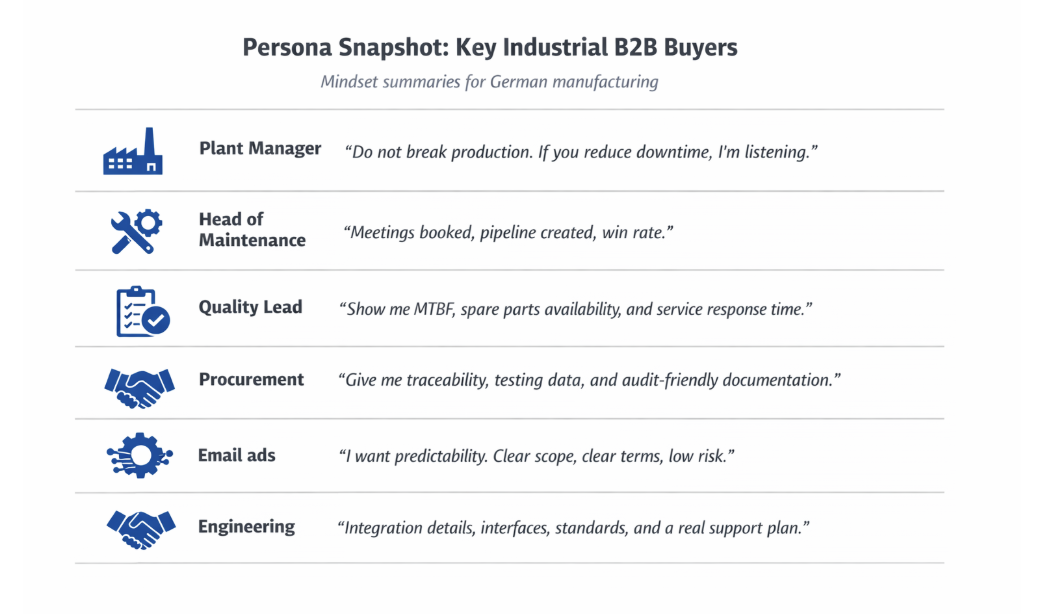
Persona Snapshot
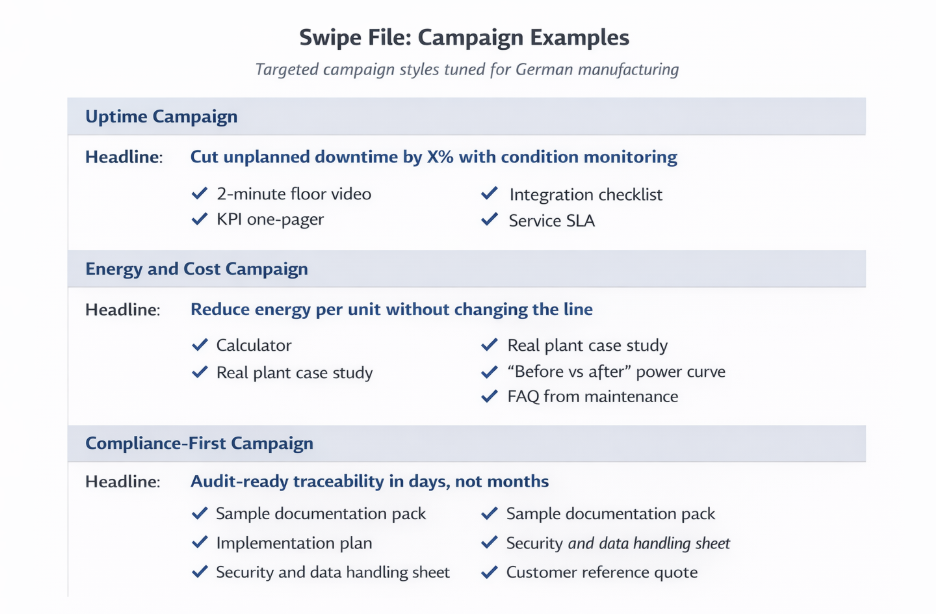
Swipe File: Campaign Examples
4. Operational Benchmarking
Operations is where German manufacturing either protects its edge… or quietly bleeds it.
You can have world-class engineering and a respected brand, but if your supply chain is fragile, your workforce is stretched, or your tech stack is stuck in 2009, the market will feel it fast.
This section looks at the operational reality on the ground: logistics, labor, tools, and the constraints shaping execution in 2026.
Supply chain and logistics (costs, delays, nearshoring trends)
German manufacturing supply chains have been rewired over the last few years. The big shift is simple:
The cheapest supply chain is no longer automatically the best supply chain.
Companies are paying more attention to:
- Lead-time stability
- Regional resilience
- Geopolitical exposure
- Supplier concentration risk
- Transport and energy volatility
Nearshoring is one of the clearest signals of this shift.
fDi Intelligence, using fDi Markets data, reported more than $82 billion pledged to manufacturing projects in 15 nearshoring destinations across Central and Eastern Europe and North Africa during 2022–2023. That was the highest two-year total on record, and about 62% higher than pre-pandemic 2018–2019 levels.
(fdiintelligence.com)
That matters for Germany because it changes the industrial map:
- Suppliers move closer
- Logistics chains shorten
- “Buffer capacity” relocates
- Competition for skilled labor spreads outward
Logistics trends: AI + sustainability become operational requirements
Logistics is also entering a new era where efficiency and sustainability are no longer separate conversations.
DHL’s Logistics Trend Radar 2024 places AI and sustainability among the most influential forces shaping logistics over the next decade.
(dhl.com)
For German manufacturers, that translates into:
- Warehouse automation
- Smarter routing and predictive ETAs
- Carbon reporting baked into transport decisions
- More end-to-end supply chain visibility
Workforce structure (team sizes, remote vs in-house, hiring trends)
If supply chain is the external constraint, labor is the internal one.
Germany’s manufacturing workforce challenge is not temporary. It’s structural.
The ifo Institute reported that 28.3% of companies still say they have too few qualified workers. The share eased slightly due to the economic slowdown, but the institute explicitly warns demographic change will worsen shortages over the long term. (ifo.de)
The Federal Employment Agency reinforces this reality, noting bottlenecks across many occupations because vacancies cannot be filled with available skilled workers. (arbeitsagentur.de)
What workforce structure looks like now
German manufacturers are increasingly designing around the assumption that:
You won’t always be able to hire your way out of the problem.
Common operational responses:
- Automation to reduce labor intensity
- Upskilling programs tied to digital tools
- More standardized processes (less tribal knowledge)
- Selective outsourcing of non-core maintenance or logistics
- Remote monitoring and support for installed equipment
Remote vs in-house in manufacturing
Most production is obviously on-site. But support layers are changing:
- Maintenance diagnostics can be remote
- Commissioning can be hybrid
- Service contracts increasingly include digital monitoring
- Engineering collaboration is more distributed than before
Tech stack (common CRMs, ERPs, AI tools)
German manufacturing tech stacks vary widely by company size, but the convergence is real.
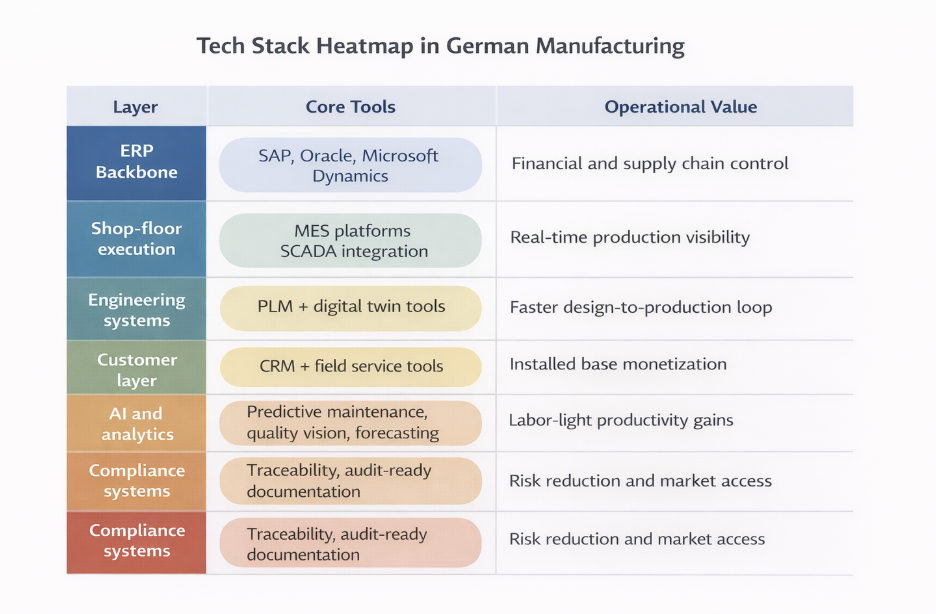
The modern industrial stack usually includes:
Core backbone systems
- ERP (finance, procurement, inventory)
- MES (shop-floor execution and visibility)
- PLM (product lifecycle and engineering data)
Customer and revenue systems
- CRM for installed base management
- Field service management platforms
- CPQ tools for complex quoting
Operational intelligence and AI layer
- Predictive maintenance models
- Computer vision for quality inspection
- Demand forecasting and inventory optimization
- Document automation for compliance workflows
Industry 4.0 adoption as a baseline expectation
Digital maturity is no longer optional.
Bitkom reports that 71% of German manufacturing companies with 100+ employees already use Industry 4.0 applications.
(bitkom.org)
Fraunhofer’s long-running Industry 4.0 work also highlights uneven progress: leaders are moving quickly, laggards struggle with funding, skills, and implementation capacity.
(fraunhofer.de)
That gap is operationally important because it creates two manufacturing economies:
- Digitally integrated factories pulling ahead
- Legacy-heavy plants fighting margin erosion
Fulfillment and customer service strategies
Industrial “fulfillment” is not Amazon-style delivery speed. It’s reliability, uptime, and service continuity.
Winning manufacturers treat fulfillment as:
- Lead-time transparency
- Spare parts availability
- Service response guarantees
- Proactive maintenance support
Aftermarket services are not just margin-rich, they are trust-rich.
McKinsey notes aftermarket services can deliver EBIT margins around 25%, far above new equipment margins near 10%.
(mckinsey.com)
Operationally, this pushes companies to invest in:
- Parts distribution hubs
- Technician enablement tools
- Remote monitoring platforms
- Lifecycle service contracts
Regulatory or compliance hurdles
Compliance has become an operational design constraint, not a legal afterthought.
Manufacturers face growing demands around:
- Traceability and documentation
- Supply chain due diligence
- Emissions and energy reporting
- Export controls and sanctions screening
- Cybersecurity expectations for connected equipment
The operational takeaway:
Compliance is now a systems problem, not a paperwork problem.
Tech Stack Heatmap
Ops KPI Table
| KPI | Why it matters | Leading indicator to track |
|---|---|---|
| OTIF (On-time in-full) | Customer trust and contract renewal | Supplier lead-time variance |
| OEE (Overall Equipment Effectiveness) | True productivity and bottlenecks | Changeover time trend |
| Scrap and rework rate | Margin leakage and quality risk | First-pass yield |
| Maintenance downtime | Capacity, safety, and uptime | Mean time between failures (MTBF) |
| Energy per unit | Cost competitiveness plus ESG reporting readiness | Peak demand spikes / demand-charge events |
| Service response time | Aftermarket growth and customer retention | First-time fix rate |
5. Competitor & Market Landscape
German manufacturing is not one market. It’s a stack of overlapping arenas that share suppliers, talent, and infrastructure, but compete on very different rules.
If you want a clean mental model, split the landscape into five “power blocs”:
- Automotive OEMs and mobility ecosystems
- Industrial automation and electrification
- Mechanical engineering and machine tools
- Chemicals and advanced materials
- Industrial software layers (the quiet force reshaping everything)
Top players and where the power concentrates
Automotive is still the biggest gravitational force.
The German auto industry remains enormous in revenue, exports, and employment. VDA’s annual figures show that in 2024, “manufacture of vehicles” sales were roughly €444 billion with an annual average workforce around 465,000, and exports were about 3.18 million passenger cars. (vda.de, vda.de)
That scale is why the automotive ecosystem (OEMs plus suppliers plus machinery) still sets the tempo for a lot of German manufacturing.
In parallel, the “factory operating system” side of manufacturing is dominated by a small set of firms with global reach, especially in automation, electrification, and industrial software. Siemens is a central reference point here, and its push into industrial AI and digital twin positioning is explicit in its public communications. (Siemens Press)
Chemicals and materials remain another core pillar, with BASF as the anchor. BASF’s 2024 report is a good primary source for the scale and structure of the sector from a German champion’s vantage point. (BASF Report 2024)
Emerging startups and disruptors
German manufacturing disruptors tend to cluster around a few wedges:
- Maintenance and uptime tech (predictive maintenance, AI-assisted service)
Example: remberg, a Munich-based maintenance platform that raised €15m (Series A+) to expand its AI-powered maintenance product for industrial firms. (EU-Startups) - Robotics and automation challengers
Humanoid and cognitive robotics is getting real commercial signals, not just demos. For example, Welt reported a large order linked to Neura Robotics and Schaeffler (structured as a multi-year plan and cooperation). Treat this as early, high-uncertainty category growth, but it signals serious intent from industrial buyers. (DIE WELT) - Defense-leaning manufacturing and dual-use production
Germany’s manufacturing base is also benefiting from defense-adjacent demand and European reindustrialization themes. The Financial Times covered a joint venture involving Quantum Systems to produce drones in Germany as part of a broader export and production push tied to Ukraine. (Financial Times)
Strategic differences in positioning, pricing, and business model
Across German manufacturing, the competitive “separation” tends to come from four things:
- Services and lifecycle monetization
The more a company earns from service contracts, spares, and upgrades, the more resilient it is in downcycles. This is not theoretical. Aftermarket services are widely cited as structurally higher-margin than new equipment, which changes both pricing power and customer stickiness. (Chemical & Engineering News) - Software layers attached to physical products
Firms that bundle software, analytics, and monitoring into equipment get higher switching costs and more defensible differentiation. This is why “digital twin” and industrial AI keep showing up in major players’ strategy narratives. (Siemens Press) - Supply assurance and lead-time credibility
Especially in sectors tied to automotive and electrification, lead time is part of the product. Nearshoring and regional capacity investments are shaping competitive postures by improving supply reliability. (Research Germany) - Compliance competence
In regulated markets, “audit-ready” is positioning. Buyers reward suppliers who can prove traceability, cybersecurity readiness, and documentation speed without drama.
Competitive Matrix (Product vs. Reach vs. Pricing)
| Player archetype | Typical examples in Germany | Product breadth | Global reach | Digital depth | Pricing posture | Best-fit customer |
|---|---|---|---|---|---|---|
| Global integrated industrial platform | Siemens | High | High | High | Premium | Enterprises buying long-term modernization |
| Engineering-first OEM with strong service footprint | Major machinery builders, premium suppliers | Medium to high | Medium to high | Medium | Premium to mid | Plants prioritizing reliability and uptime |
| Scale automotive OEM ecosystem | VW Group, BMW, Mercedes ecosystems | High | High | Medium (varies by brand/unit) | Mixed | Buyers tied to mobility platforms and supplier networks |
| Materials and chemistry backbone | BASF, other major chemical groups | High | High | Medium | Cyclical pricing + contract structures | Industries needing stable materials supply and innovation |
| Niche “hidden champion” specialist | High-end Mittelstand leaders | Narrow to medium | Medium | Medium (often improving fast) | Premium | Customers who want best-in-class performance in a niche |
| Software-first industrial disruptor | Maintenance AI, digital twin, analytics startups | Narrow | Growing | High | Subscription / value-based | Buyers who want fast ROI and measurable improvements |
SWOT-Style Summary of Top 5 Players
| Company / Player | Strengths | Weaknesses | Opportunities | Threats |
|---|---|---|---|---|
| Siemens (Automation + Industrial Software) | Deep installed base; strong integration across automation and software; leading push into industrial AI and digital twin strategy | Portfolio complexity; long enterprise sales cycles; perceived as a heavy stack for some mid-market buyers | Factory modernization; AI-enabled engineering workflows; growth in software-defined automation | Faster-moving software entrants; capex-cycle sensitivity; geopolitical disruptions |
| Bosch (Industrial Tech + Manufacturing Systems) | Broad industrial footprint; trusted engineering reputation; strong manufacturing know-how | Wide portfolio can dilute positioning; competes in crowded categories | Automation expansion; energy efficiency solutions; connected manufacturing services | Margin pressure from specialized robotics and automation competitors |
| Volkswagen Group (Automotive Manufacturing Ecosystem) | Massive production scale; strong supplier ecosystem influence; automotive remains a pillar of German industry | Heavy transformation burden (EV shift and software complexity); intense global competition | Electrification retooling; platform economics; deeper battery and software ecosystem integration | Pricing pressure from China-based OEMs; policy volatility; supply chain shocks |
| BASF (Chemicals + Materials Backbone) | Global scale; integrated production networks; deep materials science capability | Energy sensitivity; high capital intensity; cyclical margin volatility | Specialty materials for electrification; lightweighting; circular economy inputs | Global overcapacity cycles; regulatory cost shocks; sustained energy-price disadvantage |
| BMW / Mercedes-Benz (Premium Automotive Leaders) | Premium brand power; strong manufacturing execution; global demand base | Exposure to premium demand swings; high investment needs for EV and software transition | Premium EV leadership; software-enabled services; resilient supply chain redesign | Intensifying premium EV competition; regional demand volatility; trade-policy shocks |
6. Trend Analysis & Forward Outlook
German manufacturing is standing in one of those “quiet turning point” moments.
Not a collapse. Not a boom. More like a long industrial exhale, where companies are asking:
What kind of manufacturing country are we going to be in ten years?
The next phase will be shaped less by incremental efficiency and more by structural choices: energy, labor, automation, geopolitics, and the speed of digital transformation.
Macroeconomic factors (rates, inflation, regulation)
- Demand is stabilizing, but growth is not yet roaring back
The PMI story is still the clearest real-time pulse.
Germany’s manufacturing PMI improved into early 2026 but remains below the 50 line that signals expansion. That’s basically the definition of “bottoming, not booming.” (tradingeconomics.com)
This matters because in sub-50 environments, manufacturers tend to prioritize:
- Working capital discipline
- Margin protection
- Selective capex
- Service revenue stability
Not aggressive hiring sprees.
2. Skilled labor shortages remain a long-term constraint
Even with a softer economy, Germany’s labor shortage hasn’t disappeared.
The ifo Institute reported that 28.3% of companies still face a lack of qualified workers, and explicitly warns that demographic change will worsen shortages over time.
(ifo.de)
This is one of the biggest structural “ceilings” on industrial growth.
Factories can buy machines. They can’t instantly buy experienced electricians, welders, automation engineers, or maintenance specialists.
3. Trade exposure and tariff risk are rising
German manufacturing remains export-driven, and that comes with geopolitical sensitivity.
The Wall Street Journal reported that exports to the US reached their highest share in two decades in 2024 (10.4% of German exports). That’s a big concentration signal at a time when tariff uncertainty is back in the conversation. (wsj.com)
The strategic implication: companies will keep investing in regional production hedges and supply diversification.
Tech disruptions (AI, automation, new platforms)
The next industrial cycle will not just be about machines. It will be about machine intelligence.
Three technology disruptions are moving from hype into real factory budgets:
- Industrial AI and digital twin acceleration
Industrial AI is becoming a core competitive lever, not a pilot project.
Siemens has been explicit about breakthrough innovation in industrial AI and digital twin technology, positioning these tools as foundational for the next era of manufacturing productivity. (press.siemens.com)
The strategic logic is simple:
If you can simulate, predict, and optimize before you cut metal, you win on cost, speed, and quality.
2. Automation driven by labor scarcity
Automation is no longer only about efficiency. It’s about survival in a tight labor market.
With long-term demographic pressure, manufacturers are investing in:
- Robotics
- Machine vision inspection
- Predictive maintenance
- Standardized workflows
- Remote service models
The ifo labor shortage data reinforces why this trend will keep accelerating. (ifo.de)
3. Logistics tech becomes a competitive edge
Logistics is shifting from “cost center” to “strategic differentiator.”
DHL’s Logistics Trend Radar 2024 places AI and sustainability at the center of future logistics transformation. (dhl.com)
For German manufacturers, this means:
- Smarter routing and forecasting
- Warehouse automation
- Integrated emissions reporting
- End-to-end visibility
Consumer sentiment trends (industrial buyer mood)
Industrial buyers are cautious, but not frozen.
The buyer mindset right now is:
“Prove it. Make it predictable. Reduce my risk.”
That aligns with Gartner’s finding that 61% of B2B buyers prefer a rep-free buying experience, meaning buyers want control, clarity, and self-validation early in the journey. (gartner.com)
So sentiment is not anti-investment. It’s anti-uncertainty.
Predicted strategic moves (finance, marketing, ops)
Looking forward, the most likely strategic moves across German manufacturing fall into three buckets:
Finance moves
- More divestitures and carve-outs to sharpen portfolios
- Continued capability acquisitions in industrial software and automation
- Greater emphasis on recurring service revenue to stabilize cash flows
The BASF coatings deal (€7.7bn EV) is a strong example of portfolio reshaping in action. (basf.com)
Marketing moves
- More self-serve buyer experiences (spec clarity, configurators, transparent documentation)
- Account-based marketing and role-specific messaging
- Events staying important, but increasingly digitized and system-connected
Germany’s trade fair ecosystem remains huge: AUMA reported 11.7 million visitors and over 204,000 exhibitors in 2024.
(auma.de)
Ops moves
- Nearshoring and dual-sourcing expansion
- AI-enabled predictive maintenance adoption
- More automation in warehouses and shop-floor inspection
- Compliance systems embedded into operations
Nearshoring investment totals of $82bn pledged in 2022–2023 show this is already underway.
(fdiintelligence.com)
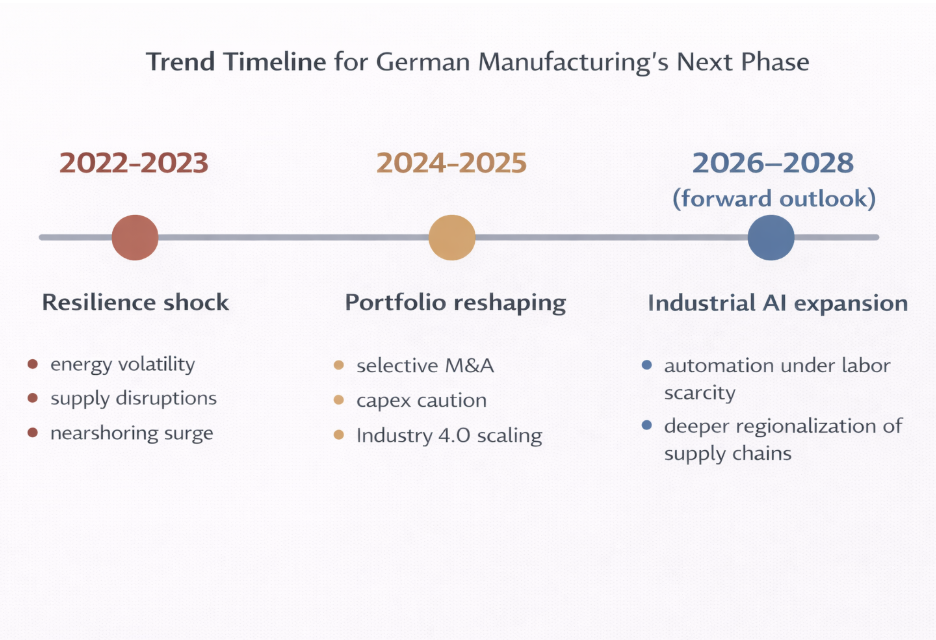
Trend Timeline
Forecasted Spend per Channel/Function
| Function / Spend Area | Forecasted Spend Direction (2026–2028) | Why Spend is Shifting | Practical Examples in German Manufacturing |
|---|---|---|---|
| Industrial AI & Analytics | Strong Increase | AI is becoming a core productivity lever as labor tightens and factories digitize | Predictive maintenance, machine vision quality control, AI-driven forecasting |
| Automation & Robotics | Increase | Workforce shortages and wage pressure make automation less optional | Robotics for repetitive tasks, automated inspection, warehouse automation |
| Aftermarket Services & Parts Infrastructure | Increase | Services provide higher-margin, more stable revenue versus cyclical equipment sales | Service contracts, spare parts hubs, remote monitoring programs |
| ERP / MES Modernization | Moderate Increase | Industry 4.0 scaling requires modern backbone systems for visibility and control | MES rollouts, shop-floor integration, digital production reporting |
| Compliance & Traceability Systems | Increase | Regulatory burden and customer audit demands require embedded compliance tools | Supply chain traceability, documentation automation, ESG reporting systems |
| Supply Chain Resilience (Nearshoring, Dual Sourcing) | Increase | Companies are prioritizing stability over lowest-cost global sourcing | Regional supplier networks, buffer capacity in Central/Eastern Europe and North Africa |
| Trade Shows & In-Person Events | Flat to Slight Decline (as % of mix) | Events remain valuable, but budgets are being balanced with digital channels | Major trade fair presence with heavier digital follow-up investment |
| Digital Marketing & Buyer Enablement | Increase | Buyers want rep-free research and self-serve clarity before sales engagement | Spec libraries, configurators, technical SEO, account-based marketing |
| Paid Media (LinkedIn, SEM) | Targeted Increase | Spend is becoming more selective, focused on high-intent roles and accounts | Retargeting operations roles, search ads for urgent downtime solutions |
| Customer Success & Field Service Tech | Increase | Installed base monetization depends on service execution and response speed | Field technician apps, SLA tracking, remote diagnostics platforms |
| Sustainability & Energy Efficiency Investments | Increase | Energy costs and ESG expectations are shaping competitive positioning | Energy monitoring, electrification upgrades, emissions optimization |
7. Strategic Recommendations
This is where the report stops being “interesting” and starts being useful.
German manufacturing leaders don’t need another trend list. They need practical moves that connect finance, marketing, and operations into one coherent play.
The biggest mistake companies make in this moment is treating these functions separately:
- Finance optimizes the balance sheet
- Marketing runs campaigns
- Operations fights fires
The winners do something else: they build a system where each function reinforces the other.
Below is a cross-functional recommendation set designed for the realities of German manufacturing in 2026–2028: labor scarcity, digital buying, supply chain regionalization, margin pressure, and the shift toward services.
Strategy Playbook Grid
| Function | Recommendation | Why it matters now (data-driven rationale) | Expected Impact |
|---|---|---|---|
| Finance | Shift mix toward services and lifecycle revenue, not just new equipment sales | Aftermarket services can deliver materially higher margins (~25% EBIT vs ~10% for new equipment), improving stability in cyclical markets | Higher profitability, smoother earnings, stronger customer retention |
| Finance | Use M&A selectively for capability gaps (industrial AI, simulation, automation software) | Recent deals like Siemens–Altair show strategic buyers paying for digital capability rather than pure capacity | Faster transformation, reduced build risk, stronger competitive moat |
| Finance | Tighten working capital discipline while protecting strategic capex | PMI conditions remain below 50, signaling stabilization but not a demand boom; cash discipline matters | Stronger resilience, better downside protection |
| Marketing | Build rep-free buyer enablement as the default front door | 61% of B2B buyers prefer a rep-free buying experience; positioning happens before sales engagement | Higher conversion, shorter cycles, improved trust |
| Marketing | Invest in technical credibility assets, not generic branding | Industrial buyers respond to proof: specs, integration guides, uptime case studies, compliance packs | Stronger shortlist rates, lower wasted leads |
| Marketing | Treat trade fairs as pipeline accelerators, not standalone campaigns | Germany’s trade fair ecosystem is massive, but ROI depends on digital follow-up systems | Better event ROI, stronger nurture-to-close performance |
| Operations | Design a labor-light operating model through automation and standardization | Skilled labor shortages persist (28.3% of firms report shortages) and are expected to intensify demographically | Higher throughput per worker, reduced operational fragility |
| Operations | Regionalize supply chains with nearshoring and dual sourcing where it reduces risk | $82bn pledged into nearshoring destinations (2022–2023) shows resilience investment is reshaping Europe | Improved OTIF, fewer disruptions, faster response times |
| Operations | Embed compliance and traceability into systems, not paperwork | Compliance is increasingly a market access requirement; audit-ready operations reduce friction | Lower regulatory risk, faster customer approvals |
| Operations | Expand AI-enabled predictive maintenance and quality automation | Industrial AI is becoming a core productivity lever; downtime reduction is one of the highest-ROI levers in factories | Reduced downtime, higher OEE, better margin protection |
Supporting Evidence (Key Anchors)
- Aftermarket services profitability advantage (25% vs 10% EBIT benchmark)
(mckinsey.com) - Buyer preference shift toward rep-free experiences (61% of B2B buyers)
(gartner.com) - Skilled labor shortage remains structural (28.3% of firms)
(ifo.de) - Nearshoring investment surge reshaping European manufacturing geography ($82bn pledged)
(fdiintelligence.com) - Strategic capability acquisition trend (Siemens–Altair industrial software expansion)
(siemens.com)
Executive-Level “If You Do Only Three Things” Summary
If a German manufacturer wants to stay ahead through 2028, the clearest play is:
- Turn the installed base into a recurring revenue engine
Services are no longer an add-on. They are the margin stabilizer. - Build a buyer experience that works without sales intervention
Your documentation, configurators, and proof assets are now part of the brand. - Automate for labor scarcity and resilience, not just cost cutting
The workforce constraint is structural. The companies that design around it will pull away.
The manufacturers that execute these moves won’t just weather the next cycle.
They’ll define the next version of “Made in Germany.”
8. Appendices & Sources
Raw Data Tables
A) Industry Snapshot Metrics (Section 1)
| Metric | Latest Value | Context | Source |
|---|---|---|---|
| Manufacturing share of gross value added (Germany) | 19.9% | Germany vs EU average 15.9% (2024) | Destatis / Eurostat |
| Manufacturing PMI (Dec 2025) | 47.0 | Below 50 indicates contraction | Trading Economics (S&P Global PMI) |
| Manufacturing PMI (Jan 2026) | 48.7 | Improving but still below expansion threshold | Trading Economics (S&P Global PMI) |
| Skilled labor shortage | 28.3% of firms | Share reporting too few qualified workers | ifo Institute |
| Nearshoring investment | >$82bn pledged (2022–2023) | Manufacturing projects in nearshoring destinations | fDi Intelligence (fDi Markets) |
B) Finance & M&A Deal Table (Section 2)
| Buyer | Seller / Target | Asset | Announced | Deal Value | Source |
|---|---|---|---|---|---|
| Carlyle + QIA-backed funds | BASF | BASF Coatings business | Oct 2025 | €7.7bn enterprise value | BASF press release |
| Siemens | Altair Engineering | Industrial simulation + software platform | 2025 | ~USD 10bn enterprise value | Siemens release (PDF) |
| Harman (Samsung subsidiary) | ZF | ADAS business | Dec 2025 | €1.5bn enterprise value | ZF press release (PDF) |
C) Marketing Channel Lead Sources (Section 3)
| Channel | Share citing as top lead source (%) |
|---|---|
| In-person tradeshows & events | 45 |
| Virtual events & webinars | 35 |
| Direct marketing | 29 |
| Email marketing | 29 |
| Directories & sponsorships | 25 |
| Paid social media | 20 |
| Search engine marketing (SEM) | 20 |
| Organic search (SEO) | 19 |
| Referrals | 20 |
| Print advertisements | 20 |
D) Forecasted Spend per Channel/Function (Section 6)
| Spend Area | Forecast Direction | Driver |
|---|---|---|
| Industrial AI & Analytics | Strong Increase | Productivity gains and labor scarcity |
| Automation & Robotics | Increase | Structural workforce constraints |
| Aftermarket Services & Parts | Increase | Higher-margin recurring revenue |
| ERP / MES Modernization | Moderate Increase | Industry 4.0 scaling and visibility |
| Compliance & Traceability Systems | Increase | Audit and regulatory pressure |
| Supply Chain Resilience | Increase | Nearshoring and dual sourcing shift |
| Trade Shows & Events | Flat / Slight Decline | Mix shift toward digital enablement |
| Digital Marketing Enablement | Increase | Rep-free buyer behavior and self-serve demand |
| Paid Media (SEM / LinkedIn) | Targeted Increase | Account-based precision spend |
| Customer Success & Field Service Tech | Increase | Installed base monetization |
| Sustainability & Energy Efficiency | Increase | Energy cost pressure and ESG positioning |
Hyperlinked source list (real citations only)
Core industry structure
- Destatis: Manufacturing share of GVA (Germany vs EU peers)
https://www.destatis.de/Europa/EN/Topic/Industry-trade-services/Industry_GVA.html
Manufacturing activity and cycle signals
- Trading Economics: Germany Manufacturing PMI
https://tradingeconomics.com/germany/manufacturing-pmi
Workforce and labor constraints
- ifo Institute: Skilled worker shortage (28.3% of firms)
https://www.ifo.de/en/facts/2025-02-17/economic-slowdown-eases-shortage-skilled-workers-germany - Federal Employment Agency: Bottleneck occupations and shortages
https://www.arbeitsagentur.de/en/press/2025-25-qualified-skilled-workers-urgently-required-shortages-in-163-occupations
Supply chain and nearshoring
- fDi Intelligence: Nearshoring surge ($82bn pledged, 2022–2023)
https://www.fdiintelligence.com/content/7944b519-4da7-56d7-b1b5-c0fdbe0e10fd
Finance and M&A
- BASF: Sale of Coatings business (€7.7bn EV)
https://www.basf.com/global/en/media/news-releases/2025/10/p-25-203 - Siemens: Acquisition of Altair (~USD 10bn EV)
https://assets.new.siemens.com/siemens/assets/api/uuid%3A5128c5fd-76ba-41cf-bb2e-7e6926362226/HQCOPR202503247128EN.pdf - ZF: Sale of ADAS business to Harman (€1.5bn EV)
https://press.zf.com/press/media/en/press_media/2025/01_global_en_and_de_2/releases_12/2025_12_23_adas/tx2025-12-23_ZF_Sells_ADAS_Business_to_In-Cabin_Electronics_Leader_Harman.pdf
Marketing and buyer behavior
- Gartner: 61% of B2B buyers prefer rep-free experience
https://www.gartner.com/en/newsroom/press-releases/2025-06-25-gartner-sales-survey-finds-61-percent-of-b2b-buyers-prefer-a-rep-free-buying-experience - McKinsey: Five fundamental truths of B2B growth (2024 pulse survey)
https://www.mckinsey.com/capabilities/growth-marketing-and-sales/our-insights/five-fundamental-truths-how-b2b-winners-keep-growing - Sagefrog: Marketing Mix Report 2025 (channel ROI + lead sources)
https://www.sagefrog.com/wp-content/uploads/2024/08/Marketing_Mix_2025_Report-v1-3.pdf
Logistics and operational transformation
- DHL: Logistics Trend Radar 2024 (AI + sustainability)
https://www.dhl.com/discover/en-global/news-and-insights/reports-and-press-releases/logistics-trend-radar-2024
Events ecosystem (Germany-specific)
- AUMA: Trade fair review 2024 (322 fairs, 11.7M visitors)
https://www.auma.de/en/latest-news/reports/detail/final-trade-fair-review-2024-all-key-figures-up-despite-series-of-strikes/
Notes on data limitations
- German manufacturing is not one market
Automotive, chemicals, machinery, automation, and industrial software operate on different cycles and margin structures. Cross-sector averages should be treated carefully. - Private-company unit economics are rarely disclosed
Metrics like CAC, LTV, burn rate, and runway are only directly observable in venture-backed or subscription-heavy models. In this report, service-margin benchmarks were used instead of invented company-level economics. - Multiples vary massively by subsector
EV/EBITDA and EV/Revenue should only be compared across true peers. For rigorous benchmarking, use KPMG’s sector multiples dataset:
https://atlas.kpmg.com/de/en/deal-advisory-services/cost-of-capital-and-multiples/industry-specific-multiples - Forward-looking spend forecasts are directional
The spend shift table reflects strategic consensus trends (AI, services, resilience) rather than audited budgets.
Disclaimer: The information on this page is provided by Manufacturing.co for general informational purposes only and does not constitute financial, investment, legal, tax, or professional advice, nor an offer or recommendation to buy or sell any security, instrument, or investment strategy. All content, including statistics, commentary, forecasts, and analyses, is generic in nature, may not be accurate, complete, or current, and should not be relied upon without consulting your own financial, legal, and tax advisers. Investing in financial services, fintech ventures, or related instruments involves significant risks—including market, liquidity, regulatory, business, and technology risks—and may result in the loss of principal. Manufacturing.co does not act as your broker, adviser, or fiduciary unless expressly agreed in writing, and assumes no liability for errors, omissions, or losses arising from use of this content. Any forward-looking statements are inherently uncertain and actual outcomes may differ materially. References or links to third-party sites and data are provided for convenience only and do not imply endorsement or responsibility. Access to this information may be restricted or prohibited in certain jurisdictions, and Manufacturing.co may modify or remove content at any time without notice.