Market Research
The State of Vietnamese Manufacturing Market Research Report
1. Industry Overview and Executive Summary
Size, CAGR, macro outlook
Vietnam is a manufacturing-first economy. A simple but telling anchor: manufacturing value added was 24.43% of Vietnam’s GDP in 2024 (World Bank). (World Bank Open Data) On near-term momentum, two “live” indicators point the same way:- Manufacturing PMI: 52.5 in January 2026. That’s expansion territory (above 50) and it marked seven straight months of improving business conditions, per S&P Global. (SP Global PMI)
- Industrial Production Index: December 2025 industrial output was up 10.1% year-on-year; processing and manufacturing specifically rose 11.9% year-on-year, according to Vietnam’s National Statistics Office. (NSO)
- If you mean manufacturing value added, the World Bank series is the right backbone, but CAGR needs a defined start/end and a consistent measure (real vs nominal). (World Bank Open Data)
- If you mean industrial output, the IIP series gives growth rates, but it’s an index, not revenue. (NSO)
- If you mean exports, you’ll get a different story again, dominated by electronics.
Key drivers of industry growth
- FDI is still the jet fuel Vietnam reported implemented FDI of $27.62B in 2025, and manufacturing/processing absorbed $22.88B of that, or 82.8%. That’s not a side plot. That is the plot. (The Investor)
- The “resilience premium” is reshaping buyer decisions A lot of buyers came to Vietnam for cost. More buyers now stay for risk management: diversification, continuity, and fewer single-country failure points. You see it in how purchasing teams talk: they ask for backup suppliers, traceability, audit readiness, and stable delivery. (More on this in marketing and ops sections later.)
- Industrial output is rising broadly, not just in one niche The IIP details matter because they signal breadth: processing and manufacturing up 11.9% YoY in December 2025 while electricity, water/waste, and mining also moved (at different rates). That pattern reads like a system strengthening, not just one hot subsector. (NSO)
Cross-functional summary: financial, marketing, ops
Finance summary Vietnam manufacturing is expanding with outside capital and export-linked capacity. Implemented FDI hit a five-year high in 2025 and is heavily concentrated in manufacturing/processing. (The Investor) What to watch (even at the macro level): working capital stress (receivables), FX exposure, and capex cycles. These show up before headline growth rolls over. Marketing summary (B2B reality) The buying job has changed. It used to be “find a factory.” Now it’s “find a factory and prove it won’t embarrass me later.” That shift changes what works in marketing: proof beats polish. The best-performing “campaign assets” in Vietnamese manufacturing are usually capability matrices, quality metrics, certifications, audit readiness packs, and fast, clear quoting workflows. Operations summary Vietnam’s ops advantage is becoming less about cheap labor alone and more about system reliability: lead times, consistent quality, documentation, and logistics throughput. The PMI commentary for January 2026 points to sustained demand and ongoing improvement, which tends to reward factories that can keep schedules steady when volume rises. (SP Global PMI)Industry Snapshot Table
| Metric | Latest datapoint | What it signals |
|---|---|---|
| Manufacturing value added (% of GDP) | 24.43% (2024) Source | Manufacturing is structurally central to the economy |
| Manufacturing PMI | 52.5 (Jan 2026) Source | Current expansion and improving business conditions |
| Industrial Production Index (overall) | +10.1% YoY (Dec 2025) Source | Broad industrial acceleration |
| Processing and manufacturing output | +11.9% YoY (Dec 2025) Source | The factory core is growing faster than the overall index |
| Implemented FDI | $27.62B (2025) Source | Capital formation remains strong |
| Implemented FDI into manufacturing/processing | $22.88B; 82.8% share (2025) Source | The investment mix is overwhelmingly manufacturing-led |
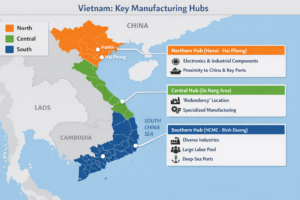
Global Hubs or Growth Geographies Map
2. Finance and Investment Landscape
This is where the Vietnamese manufacturing story gets interesting. On the surface, it looks like a classic export-driven growth narrative. Underneath, it’s a capital allocation story: where global money is flowing, how factories earn (and protect) margin, and which financial signals matter before problems show up in headlines.Recent M&A Activity
Vietnam’s manufacturing M&A activity is highly strategic rather than purely financial. Deals often revolve around supply chain positioning, technology acquisition, or regional capacity expansion rather than roll-up plays.Deal Table
| Date | Buyer | Target | Sector | Deal Value | Source |
|---|---|---|---|---|---|
| Oct 2024 | SK Group (Korea) | Iscvina Manufacturing Co. | Semiconductor manufacturing | $300M | The Asset |
| 2025 | Panjit International (Taiwan) | 95% stake in Torex Vietnam Semiconductor | Semiconductor manufacturing | Undisclosed | Vietnam Investment Review (VIR) |
| 2025 | Mitsubishi Materials (Japan) | H.C. Starck Holding (divested by Masan) | Advanced materials | $134.5M | ASL Law (deal list) |
Investment Trends: FDI, Capex, and Capital Allocation
Vietnam recorded implemented FDI of $27.62B in 2025, the highest level in five years. Of that, $22.88B (82.8%) flowed into processing and manufacturing. Source: https://theinvestor.vn/vietnams-2025-fdi-disbursement-hits-5-year-high-d18057.html That concentration is not normal by global standards. It signals three things:- Manufacturing is still the main foreign-capital magnet.
- Industrial parks and export infrastructure remain priority policy areas.
- Growth is capacity-led, not just consumption-led.
Revenue Models and Unit Economics
Vietnamese manufacturing firms generally fall into three economic structures:- Contract Manufacturing (EMS, assembly, textiles CMT) Revenue: Per-unit or per-process contracts Margin driver: Utilization rate and yield Risk: Capacity underfill
- OEM/FOB Export Manufacturing Revenue: Full-package pricing including sourcing Margin driver: Procurement efficiency + production control Risk: Input cost volatility
- Specialized Component Manufacturing Revenue: Higher-spec components with technical validation Margin driver: Quality consistency, lower scrap, process capability Risk: Customer concentration
Financial Health Indicators
Manufacturing stress does not show up first in net income. It shows up in operational finance metrics:- Days Sales Outstanding (DSO) – rising DSO is an early warning
- Scrap and rework cost trends
- Capacity utilization (below 70% often compresses margin sharply)
- Energy cost per unit (critical in export-intensive production)
- Working capital cycle length
Capital Structure Trends
Vietnamese manufacturers commonly finance growth through:- Bank debt tied to working capital • Industrial park land leases • Joint ventures with foreign investors • Strategic minority stakes
LTV:CAC Ratio Chart
| LTV:CAC Ratio | Interpretation | What it usually means in manufacturing |
|---|---|---|
| < 2x | Weak | You’re spending too much to win accounts relative to the gross profit you keep. Common causes: underpriced bids, too many low-fit RFQs, or heavy onboarding costs that aren’t recovered. |
| 2x–3x | Workable / tight | Economics can hold, but there’s little margin for mistakes. You typically need strong working capital discipline and a plan to expand accounts post-win. |
| 3x–6x | Healthy | Good balance between acquisition cost and lifetime gross profit. This band often supports investments in QA systems, automation, and faster quoting without breaking the model. |
| 6x+ | Strong but verify | Great on paper, but double-check customer concentration and pricing sustainability. One oversized buyer or unusually favorable contract can inflate LTV temporarily. |
EV/Revenue + EV/EBITDA Multiples
| Segment | EV/Revenue (typical range) | EV/EBITDA (typical range) | Notes |
|---|---|---|---|
| Commodity manufacturing | 0.5x–1.5x | 4x–8x | Often price-competitive, lower differentiation; multiples are sensitive to cycle risk. |
| Branded export manufacturers | 1.5x–3x | 8x–14x | Generally stronger pricing power and repeat demand; brand + customer stickiness can support higher multiples. |
| High-tech components | 2x–5x | 12x–20x | Higher technical barriers and qualification cycles; customer concentration risk can still be material. |
3. Marketing Performance and Trends
If finance tells you where capital is flowing, marketing tells you where trust is flowing. In Vietnamese manufacturing, trust is the currency. And the buyers have become a lot more selective over the past few years. This isn’t consumer marketing. This is high-stakes B2B procurement. The messaging, channels, and buyer psychology reflect that.Channel Breakdown: What Actually Drives Deals
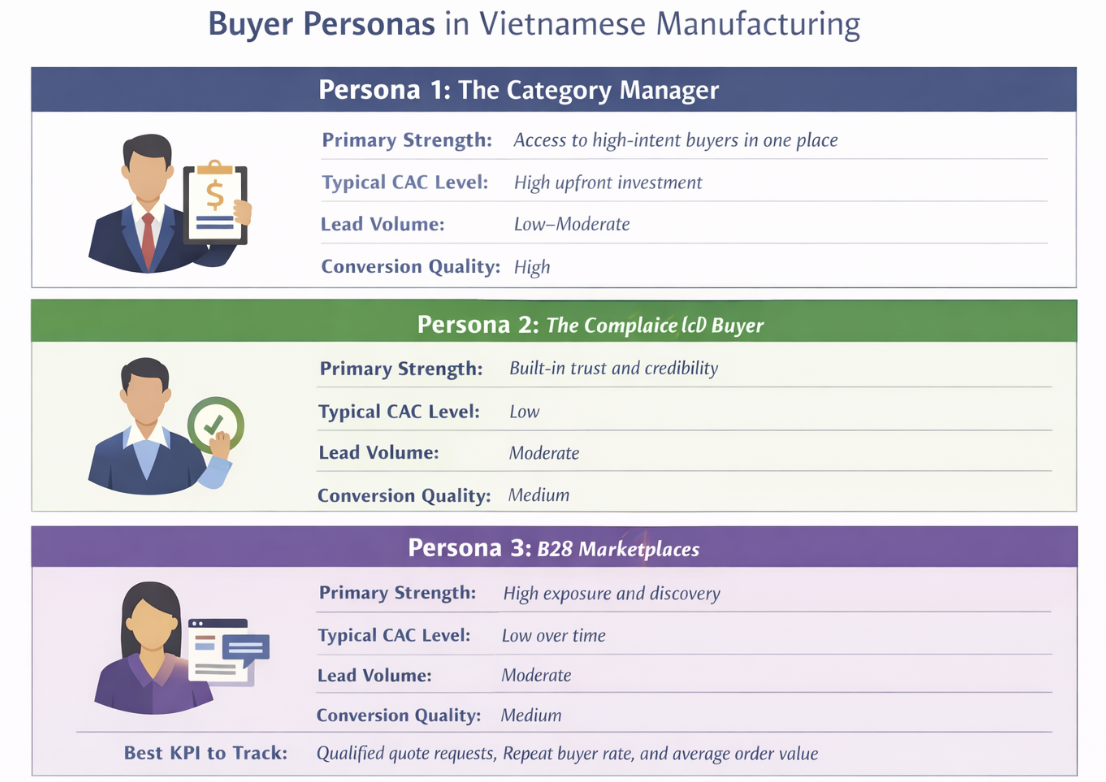
Vietnamese manufacturers generally rely on a mix of relationship-based and digital channels. The balance varies by subsector (electronics vs garments vs components), but the structure looks like this: Trust-First Channels (High Conversion, Lower Volume) • Trade shows (Global Sources, Canton-adjacent sourcing events, industry expos) • Direct buyer referrals • Broker or sourcing-agent networks • Existing customer expansion These channels produce fewer leads, but higher-quality RFQs and faster closing cycles. Demand Capture Channels (Higher Volume, Variable Quality) • B2B marketplaces (Alibaba, Global Sources, Made-in platforms) • SEO for product + “Vietnam OEM/ODM” queries • LinkedIn outbound targeting category managers • Email outreach to historical buyer lists The strongest performers blend both. High-performing factories don’t rely on just inbound volume. They combine inbound with credibility reinforcement.Multi-Channel Performance Table
| Channel | Primary Strength | Typical CAC Level | Lead Volume | Conversion Quality | Best KPI to Track |
|---|---|---|---|---|---|
| Trade Shows | Access to high-intent buyers in one place | High upfront investment | Low–Moderate | High | RFQ-to-PO conversion rate |
| Referrals | Built-in trust and credibility | Low | Low | Very High | Time-to-close and repeat order rate |
| LinkedIn Outbound | Precise buyer targeting | Moderate | Moderate | Medium | Meeting-to-RFQ ratio |
| SEO (Organic Search) | Compounding inbound visibility | Low over time | Moderate | Medium | Qualified quote requests |
| B2B Marketplaces | High exposure and discovery | Moderate | High | Low–Medium | Repeat buyer rate and average order value |
| Email Nurturing | Reactivates dormant leads and past buyers | Low | Moderate | Medium–High | Re-engagement rate and RFQ reactivation |
Buyer Behavior Trends
The biggest shift isn’t channel. It’s mindset. Buyers sourcing from Vietnam today are primarily motivated by:- Risk Diversification Vietnam continues to benefit from global supply-chain diversification across Southeast Asia, often described as “China+1.” Source: https://www.mckinsey.com/industries/logistics/our-insights/diversifying-global-supply-chains-opportunities-in-southeast-asia
- Compliance and Traceability Exporters increasingly face ESG due diligence and supply chain transparency requirements, particularly for EU-linked value chains. Source: https://www.lexology.com/library/detail.aspx?g=6d8d6f1a-1b4e-4e8c-a506-43136e53363e
- ESG and Sustainability Expectations Vietnamese firms are actively improving ESG reporting maturity, though capability levels vary significantly. Source: https://www.pwc.com/vn/en/publications/2025/esg-progress-tracker-2025.pdf
- Audit readiness • Material traceability • Quality documentation systems • Clear origin documentation • Environmental reporting capability
Creative and Messaging That Performs
In Vietnamese manufacturing marketing, flashy rarely wins. Specificity wins. High-performing messaging elements:- “Here is our defect rate (PPM)” • “Here is our lead time breakdown by stage” • “Here is our audit history and certifications” • “Here is how we reduced cost for a similar client”
Market Positioning Trends
Vietnam’s brand positioning globally has evolved: 2015–2018: Cost-effective alternative 2019–2022: Supply chain diversification hub 2023–2026: Capable, growing, compliance-conscious manufacturing base The factories gaining share now are those repositioning from “low-cost” to “reliable and documented.” Brand perception increasingly depends on:- Communication speed • Engineering collaboration • Transparency • Energy and sustainability strategy
Persona Snapshot
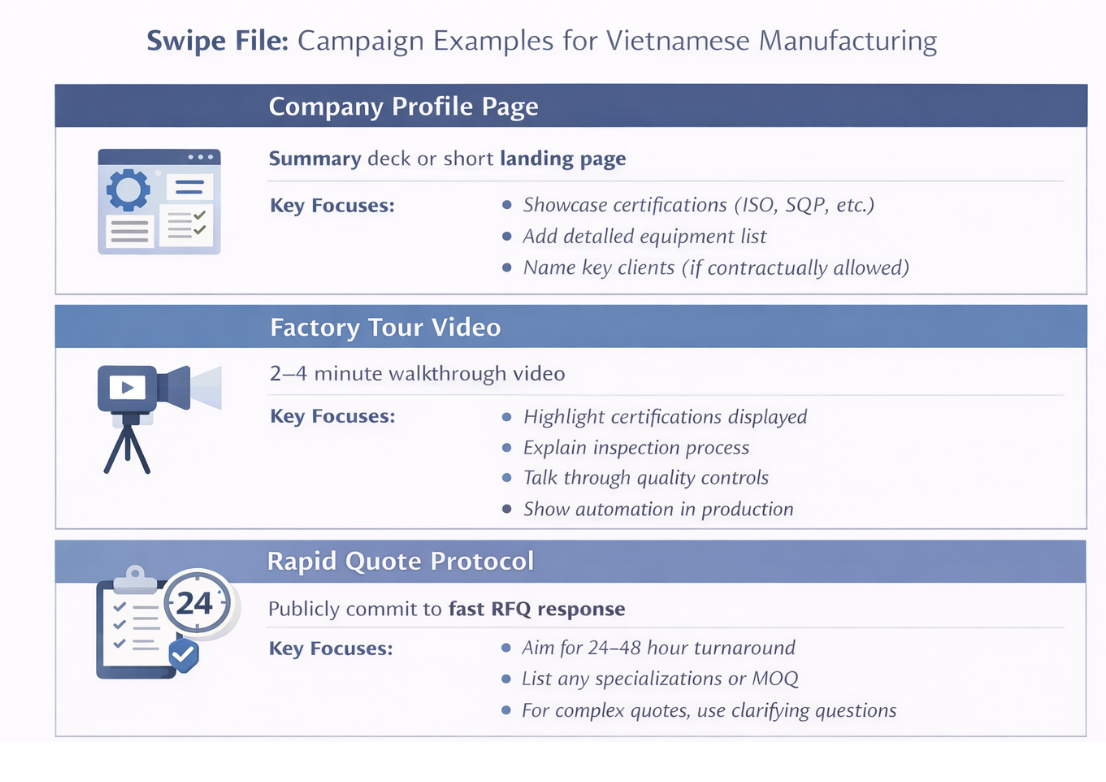
Swipe File: Campaign Examples
4. Operational Benchmarking
This is where Vietnam’s manufacturing advantage is either protected or lost. Margins don’t disappear because of marketing mistakes. They disappear because of scrap, delays, rework, missed vessels, and slow corrective action. Section 4 focuses on what separates average factories from resilient ones.Supply Chain and Logistics
Vietnam’s logistics backbone has strengthened meaningfully over the past decade. Three container ports rank among the world’s 100 busiest by throughput, including Ho Chi Minh City, Hai Phong, and Cai Mep–Thi Vai. Source: https://news.baohaiphong.vn/hai-phong-port-ranks-30th-globally-in-container-throughput-519562.html The implications are real:- Export routing capacity is no longer a structural bottleneck. • Deep-sea capability (Cai Mep–Thi Vai) reduces reliance on transshipment for certain lanes. • Northern corridor proximity to China-linked suppliers shortens upstream lead times.
Workforce Structure
Vietnam’s labor force remains one of its strongest structural advantages. However, wages are rising gradually, particularly in industrial zones. Manufacturing salary benchmarks indicate upward pressure in recent years. Source: https://www.talentnetgroup.com/vn/featured-insights/compensation-benefits/manufacturing-compensation-vietnam-factory-salary-data Implications:- Automation ROI is improving year over year. • Labor-intensive segments (garments, furniture) face margin compression risk without productivity upgrades. • Skilled technician retention is becoming a competitive differentiator.
- Design, sampling coordination, and customer support may be partially remote. • International sales teams are often regionally distributed.
Tech Stack in Vietnamese Manufacturing
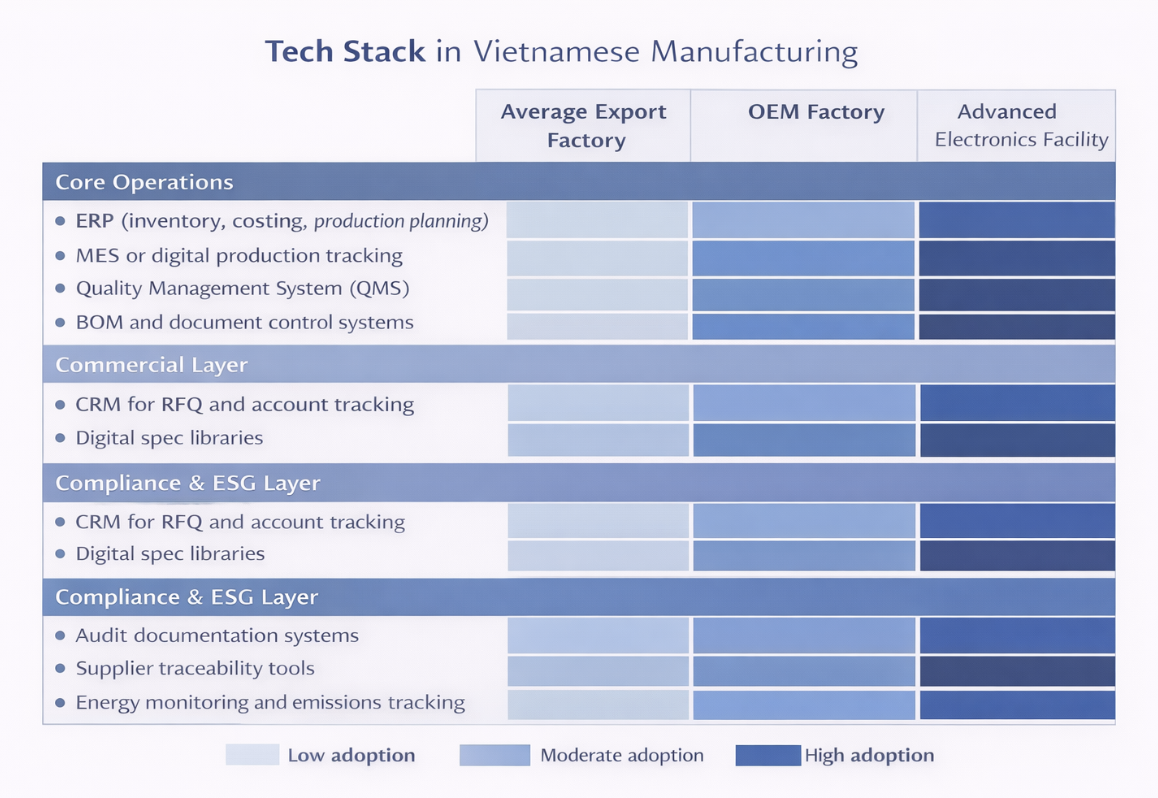
Operational tech maturity varies significantly across firms. Export-focused factories increasingly deploy structured systems across four categories: Core Operations • ERP (inventory, costing, production planning) • MES or digital production tracking • Quality Management System (QMS) • BOM and document control systems Commercial Layer • CRM for RFQ and account tracking • Digital spec libraries • Version-controlled technical documentation Compliance and ESG Layer • Audit documentation systems • Supplier traceability tools • Energy monitoring and emissions tracking Vietnamese businesses show improving ESG reporting maturity, though gaps remain between leading and mid-tier firms. Source: https://www.pwc.com/vn/en/publications/2025/esg-progress-tracker-2025.pdfFulfillment and Customer Service Strategy
Operational excellence in Vietnam now includes communication speed, not just production speed. Best-in-class exporters typically have:- 24–48 hour RFQ acknowledgment • Defined corrective action (8D-style) reporting • Dedicated customer service engineers • Shipment milestone updates
Regulatory and Compliance Hurdles
Two pressure points stand out:- Origin Scrutiny and Trade Enforcement Vietnam faces heightened scrutiny regarding transshipment and tariff circumvention risks in certain sectors. Source: https://www.ft.com/content/d214d732-4126-406b-a926-3850a6168333
- ESG Due Diligence European-linked supply chains increasingly require documentation of environmental and labor compliance. Source: https://www.lexology.com/library/detail.aspx?g=6d8d6f1a-1b4e-4e8c-a506-43136e53363e
Tech Stack Heatmap
Ops KPI Table
| KPI | What Strong Performance Looks Like | Why It Matters |
|---|---|---|
| On-Time Delivery | 95%+ on-time shipments with a stable or improving trend | Protects buyer trust and reduces expedite costs and chargebacks |
| First-Pass Yield | Stable or improving yield; low rework and minimal line stoppages | Direct margin protection through lower cost of poor quality |
| Scrap Rate | Declining scrap; root causes tracked and prevented (not just sorted out) | Scrap quietly eats gross margin and inflates lead times |
| DSO (Days Sales Outstanding) | Stable by customer segment; exceptions flagged early | Working capital health; rising DSO is an early warning signal |
| RFQ Response Time | Under 48 hours for acknowledgement; 48–72 hours for most quotes | Speed increases win probability and signals operational discipline |
| CAPA Closure Time | Most corrective actions closed within ~30 days with clear verification | Shows process control and prevents repeat defects |
| Energy Cost per Unit | Measured per SKU or per production line; tracked monthly with targets | Energy is a growing share of export costs and affects sustainability reporting |
| Order Cycle Time | Lead times tracked by stage (sampling, production, QC, ship) and improving | Improves planning accuracy and reduces missed vessel risk |
| Inventory Accuracy | High cycle-count accuracy; minimal production stoppages due to stock errors | Prevents line downtime and reduces working capital waste |
| Customer Claims Rate | Low and trending down; fast containment when issues occur | Reduces warranty/returns and protects repeat business |
5. Competitor and Market Landscape
Vietnamese manufacturing isn’t one neat “industry.” It’s a portfolio of subsectors that behave differently: electronics runs on FDI-led ecosystems, textiles run on scale + speed + compliance, heavy industry runs on capex and domestic infrastructure demand, and industrial parks are the “picks and shovels” that enable everyone else. So instead of pretending there’s one universal market-share leaderboard, this section maps the competitive landscape by the arenas that actually decide who wins.How to think about “top players” in Vietnam manufacturing
There are three layers of competition: Layer A: Global OEMs and EMS ecosystems (electronics, devices, components) These firms drive export volume, technology standards, and supplier qualification requirements. Vietnam Investment Review notes major global tech players such as Samsung, Apple, LG, and Pegatron expanding production and investment in Vietnam. It also highlights the sector’s heavy dependence on foreign-invested firms. Source: https://vir.com.vn/vietnams-electronics-sector-rising-fast-but-structural-hurdles-remain-131838.html Layer B: National champions (textiles/garments, steel, materials, plastics) These firms shape domestic supply depth and, in some categories, export competitiveness. For example, Hoa Phat reports a 77% profit increase in 2024 and exports accounting for 31% of group revenue, signaling scale and competitiveness in heavy industry. Source: https://www.hoaphat.com.vn/news/hoa-phat--s-after-tax-profit-soars-77-to-over-vnd12-trillion-in-2024.html Layer C: Industrial infrastructure developers (industrial parks, logistics clusters) These are platform players. They don’t ship iPhones or shirts, but they determine whether the factories that do can scale quickly. Sembcorp and Becamex stated their partnership had reached 20 Vietnam-Singapore Industrial Parks (VSIPs) as of March 12, 2025. Source: https://www.sembcorp.com/media/ufpnipo2/sembcorp-and-becamex-partnership-expands-to-20-vietnam-singapore-industrial-parks.pdfSubsector snapshots: who dominates what
Electronics and high-tech manufacturing What dominance looks like: export value and ecosystem gravity. VIR reports electronics export turnover of $134.5B in 2024 and explicitly notes major global players (Samsung, Apple, LG, Pegatron) expanding in Vietnam. Source: https://vir.com.vn/vietnams-electronics-sector-rising-fast-but-structural-hurdles-remain-131838.html Also useful context from the same source:- The US is cited as Vietnam’s largest electronics export destination, around 29% of the sector’s export value.
- Structural constraint: high dependence on foreign investors and imported components. Source: https://vir.com.vn/vietnams-electronics-sector-rising-fast-but-structural-hurdles-remain-131838.html
Emerging startups or disruptors (what “disruption” really means here)
In manufacturing, “disruptor” usually means one of these patterns, not a flashy app:- Automation-first factories They win by stabilizing quality (lower variance), not just lowering labor. This aligns with the broader electronics push toward automation and standardization described by industry experts in Vietnam’s electronics ecosystem. Source: https://vir.com.vn/vietnams-electronics-sector-rising-fast-but-structural-hurdles-remain-131838.html
- Compliance-first exporters They treat traceability, audit packs, and ESG documentation as part of the product. This matters because Vietnam’s export manufacturing is increasingly evaluated on transparency and standards, not just cost and speed (again echoed in electronics sector commentary on standards and sustainability). Source: https://vir.com.vn/vietnams-electronics-sector-rising-fast-but-structural-hurdles-remain-131838.html
- “Materials with a story” manufacturers (bioplastics, recycled plastics, specialty materials) These players compete on buyer requirements (EU/US sustainability filters) and procurement category shifts. A concrete example of the ecosystem direction is An Phat’s positioning around biodegradable materials and global-standard products. Source: https://anphatinternational.com/wp-content/uploads/Eng_Company-Profile-APH.pdf
Competitive Matrix
| Player type / examples | Product complexity | Geographic reach | Compliance maturity | Typical edge |
|---|---|---|---|---|
| Global electronics OEM/EMS ecosystem (Samsung, Apple supply chain, LG, Pegatron) | High | Global | High | Deep qualification standards, large-scale output, export “pull-through” into supplier tiers |
| National textile and garment leaders (Vinatex ecosystem; large exporters under VITAS umbrella) | Medium | Global | Medium–High | Speed and scale, established buyer relationships, improving domestic value-add |
| Heavy industry champions (Hoa Phat) | Medium–High | Regional–Global | Medium | Scale economics, integrated production capacity, broad export footprint |
| Industrial park platforms (VSIP: Sembcorp + Becamex) | N/A (platform) | National | High (tenant-driven) | Fast factory deployment, strong infrastructure, tenant ecosystem and credibility for foreign investors |
SWOT-Style Summary of Top 5 Players
| Player / Ecosystem | Strengths | Weaknesses | Opportunities | Threats |
|---|---|---|---|---|
| Samsung-led Electronics Footprint (Vietnam ecosystem role) | Global demand pull; advanced manufacturing standards; export-scale gravity; strong supplier ecosystem influence | High dependence on imported components; ecosystem concentration risk | Deeper localization of tier suppliers; more automation; higher domestic value-add | Tariff shifts; geopolitical shocks; rising labor competition |
| Pegatron (EMS expansion pattern in Vietnam) | Strong global customer relationships; ability to scale production quickly; integration into major tech supply chains | Thin margins typical of EMS; customer concentration risk | Vietnam as diversification hub; capacity expansion aligned with global OEM shifts | Demand cyclicality; ongoing pricing pressure from OEM customers |
| Vinatex (Textile & Garment anchor) | Large-scale production network; sector coordination; strong export positioning | Exposure to global apparel demand volatility; cost sensitivity | Higher domestic value-add; stronger compliance positioning; sustainability-led differentiation | Competition from Bangladesh and China; increasing ESG scrutiny; wage inflation |
| Hoa Phat (Steel & Heavy industry) | Integrated production model; scale advantage; broad export footprint; improving profitability | High exposure to commodity cycles; capital-intensive operations | Infrastructure demand growth; export expansion; product diversification | Global steel price swings; trade barriers; input cost volatility |
| VSIP platform (Sembcorp + Becamex) | Established industrial park network; strong FDI credibility; high infrastructure quality | Land and regulatory complexity; dependent on sustained FDI demand | Growth in green industrial parks; expansion of ready-built factories; continued supply chain diversification | Macro slowdown; regulatory tightening; stronger competition from other ASEAN locations |
6. Trend Analysis and Forward Outlook
If the previous sections explained where Vietnam’s manufacturing sector stands today, this one answers the harder question: where is it headed? The short version: the next phase will be defined less by labor cost arbitrage and more by capital efficiency, automation depth, regulatory alignment, and geopolitical positioning.Macroeconomic Forces Shaping the Sector
Trade Policy and Tariff Risk Vietnam has benefited from global supply chain diversification, but it also faces increasing scrutiny around origin rules and transshipment concerns in certain sectors. Coverage in the Financial Times highlights how Southeast Asian export hubs, including Vietnam, are navigating heightened enforcement and tariff policy volatility. This matters because Vietnam’s manufacturing model is export-led. When tariffs shift, margins shift. Operational implication: factories that localize more of their supply chain reduce risk exposure. Global Demand Cycles Vietnam’s manufacturing performance is closely tied to US and EU consumption patterns. Electronics and apparel are particularly sensitive to Western consumer demand. The latest Vietnam Manufacturing PMI reading (52.5 in January 2026) indicates expansion and improving business conditions. Source: https://www.pmi.spglobal.com/Public/Home/PressRelease/21fc2173ebc24d0fb01c2bec5e2a46a9 As long as PMI remains above 50, forward momentum remains intact. A sustained drop below 50 would be an early warning signal. FDI Momentum Implemented FDI reached $27.62B in 2025, with manufacturing accounting for 82.8% of the total. Source: https://theinvestor.vn/vietnams-2025-fdi-disbursement-hits-5-year-high-d18057.html That concentration reinforces one truth: Vietnam’s growth engine is still capital-intensive industrial expansion.Technology Disruption
Automation and Smart Manufacturing Automation ROI improves each year as wages rise and buyer quality expectations increase. The next wave is not full “lights-out” factories. It is targeted automation:- Vision inspection systems • Automated testing lines • Predictive maintenance tools • Digital production dashboards
- Defect detection via computer vision • Production scheduling optimization • Energy consumption forecasting • Demand and inventory planning
- Rooftop solar expansion • Energy monitoring systems • Carbon accounting tools • Green industrial parks
Consumer and Buyer Sentiment Trends
Buyers are more cautious but not retreating. Three noticeable shifts:- Dual-sourcing is standard Instead of relocating entirely to Vietnam, buyers are splitting production across countries.
- Documentation is expected, not impressive Audit packs and traceability used to be differentiators. Now they are minimum requirements.
- Engineering collaboration is rising Buyers want cost-down suggestions, not just execution. Manufacturers who provide DFM (Design for Manufacturability) input gain stickier relationships.
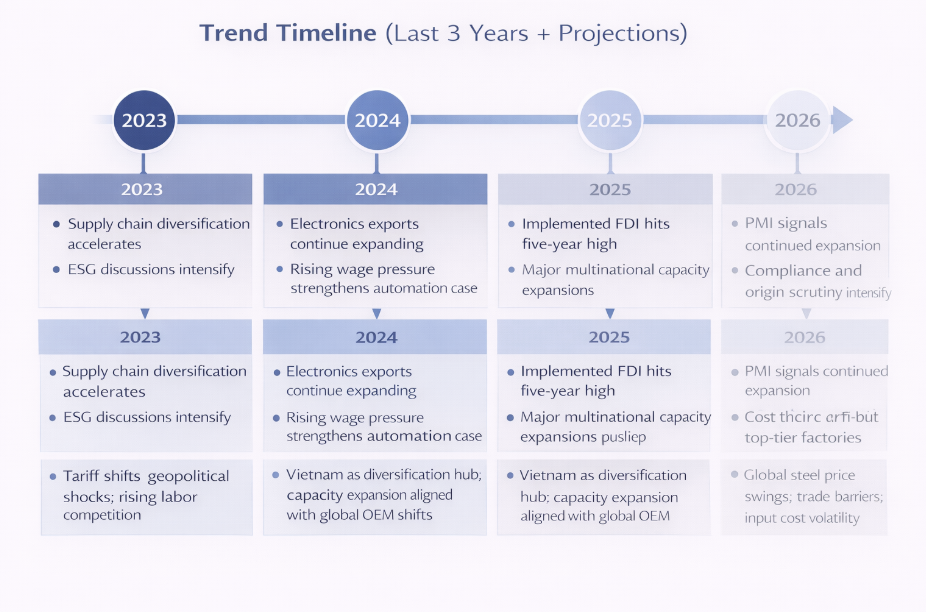
Trend Timeline (Last 3 Years + Projections)
Forecasted Strategic Spend Shifts
| Function | Expected Spend Trend | Rationale |
|---|---|---|
| Automation Equipment | Increasing | Wage growth increases automation ROI; automation also improves yield and reduces variance. |
| Energy Infrastructure | Increasing | Energy monitoring and renewables support cost control and align with buyer ESG expectations. |
| Compliance Systems | Increasing | Tighter origin scrutiny and buyer audit requirements push investment in traceability and documentation. |
| Sales & Account Management | Stable–Increasing | More qualification steps and longer buying committees increase the need for structured account coverage. |
| Manual Labor Expansion | Slower growth | Factories increasingly offset labor needs through process improvement and targeted automation. |
7. Strategic Recommendations
This is where the report stops describing the market and starts making moves. Vietnamese manufacturing is entering a capability phase. The winners over the next five years won’t simply be those with the lowest labor cost. They’ll be the ones that tighten capital efficiency, reduce operational variance, and turn compliance into commercial leverage.Strategy Playbook Grid
| Function | Recommendation | Key Actions | Expected Impact |
|---|---|---|---|
| Finance | Expand LTV per customer (post-sale growth focus) | Conduct structured account reviews every 6–12 months; proactively propose cost-down engineering; bundle additional SKUs | Improves unit economics; reduces reliance on constant new customer acquisition |
| Finance | Tighten working capital discipline | Segment customers by payment behavior; negotiate milestone billing for tooling/NRE; monitor DSO weekly for top accounts | Strengthens liquidity; lowers cash-flow volatility during export cycles |
| Finance | Invest in targeted automation with clear ROI gates | Prioritize high-scrap or high-variance processes; model conservative payback; focus automation on yield improvement | Stabilizes margins; reduces quality escapes and rework costs |
| Marketing | Shift from capacity-led messaging to proof-led positioning | Publish yield/defect/lead-time data; build downloadable compliance sheets; implement a 24–48 hour RFQ response promise | Increases RFQ-to-PO conversion; improves buyer trust |
| Marketing | Reallocate budget toward high-trust channels | Improve trade show preparation; formalize referral programs; refine LinkedIn outbound targeting by buyer persona | Lowers blended CAC; improves lead quality |
| Operations | Digitize traceability and documentation systems | Integrate BOM control into ERP/QMS; standardize audit response templates; centralize compliance documentation | Faster audit response; higher retention in EU/US markets |
| Operations | Make energy strategy a commercial advantage | Install energy monitoring; evaluate rooftop solar ROI; publish sustainability metrics where feasible | Differentiates in ESG-sensitive procurement processes |
| Operations | Institutionalize corrective action speed | Adopt structured CAPA/8D system; set 30-day closure targets; track repeat defect rates | Reduces claims; strengthens long-term customer relationships |
Cross-Functional Alignment Priorities
Priority 1: Variance Reduction Every function should reduce variability. Finance: stabilize cash cycles Marketing: stabilize lead quality Operations: stabilize yield and delivery Variance is the silent margin killer. Priority 2: Buyer Stickiness The strongest factories convert operational strength into long-term contracts. Tactics: • Multi-year agreements • Engineering co-development • SKU bundling • Shared cost-reduction projects Priority 3: Capability Signaling Vietnam’s brand has moved from low-cost to reliable and growing. Factories that signal maturity clearly — documentation, transparency, responsiveness — close larger accounts.Risk-Mitigation Playbook
Risk: Tariff or regulatory shifts Mitigation: • Diversify export destinations • Increase local content ratio Risk: Wage acceleration Mitigation: • Lean implementation • Targeted automation • Workforce upskilling Risk: Demand slowdown Mitigation: • Diversify customer portfolio • Expand into adjacent verticals • Offer smaller MOQ options for emerging brandsStrategic Positioning Archetypes
Factories in Vietnam typically fall into one of four strategic archetypes:- Cost Leader Focus: Scale + efficiency Risk: Margin compression if automation lags
- Quality Leader Focus: Low defect rates + certifications Risk: Higher fixed cost base
- Flexible Specialist Focus: Small batch, high mix production Risk: Operational complexity
- Sustainability-Forward Manufacturer Focus: Energy transparency + ESG leadership Risk: Upfront capital requirements
3-Year Strategic Roadmap Framework
Year 1 • Digitize core documentation • Implement DSO discipline • Improve quote turnaround speed Year 2 • Automate highest-variance processes • Launch structured account expansion program • Deploy energy monitoring systems Year 3 • Localize critical suppliers • Integrate predictive analytics tools • Position as preferred supplier for multi-SKU programs8. Appendices and Sources
This section is where we pull the curtain back. Every serious industry report should show its math, its sources, and its limits. Vietnam’s manufacturing sector is broad and export-heavy, which means definitions matter. “Size” depends on whether you’re measuring value added, output index, exports, or company revenue.Raw Data Tables
Macro and Activity Indicators
| Metric | Period | Value | Unit | Source |
|---|---|---|---|---|
| Manufacturing value added share of GDP | 2024 | 24.43 | Percent | World Bank WDI (NV.IND.MANF.ZS): link |
| Manufacturing PMI | 2026-01 | 52.5 | Index | S&P Global Vietnam Manufacturing PMI: link |
| Industrial Production Index (IIP) YoY | 2025-12 | 10.1 | Percent | Vietnam National Statistics Office (IIP): link |
| Processing & manufacturing output YoY | 2025-12 | 11.9 | Percent | Vietnam National Statistics Office (IIP): link |
| Implemented FDI | 2025 | 27.62 | USD billions | The Investor: link |
| Manufacturing share of implemented FDI | 2025 | 82.8 | Percent | The Investor: link |
Electronics and Textile Export Data
| Metric | Period | Value | Unit | Source |
|---|---|---|---|---|
| Electronics export turnover | 2024 | 134.5 | USD billions | Vietnam Investment Review: link |
| Textile & garment export forecast | 2025 | 46 | USD billions | VnEconomy (citing VITAS): link |
| Textile trade surplus forecast | 2025 | 21 | USD billions | VnEconomy (citing VITAS): link |
Heavy Industry and Industrial Platform Data
| Metric | Period | Value | Unit | Source |
|---|---|---|---|---|
| Hoa Phat after-tax profit | 2024 | 12 | Trillion VND | Hoa Phat corporate release: link |
| Hoa Phat export share of revenue | 2024 | 31 | Percent | Hoa Phat corporate release: link |
| VSIP industrial parks (Sembcorp + Becamex) | 2025 | 20 | Count | Sembcorp press release (PDF): link |
Hyperlinked Source List
Macroeconomic and Industrial Data World Bank Manufacturing Share of GDP https://data.worldbank.org/indicator/NV.IND.MANF.ZS?locations=VN S&P Global Vietnam Manufacturing PMI https://www.pmi.spglobal.com/Public/Home/PressRelease/21fc2173ebc24d0fb01c2bec5e2a46a9 Vietnam National Statistics Office (Industrial Production Index) https://www.nso.gov.vn FDI Reporting (Implemented FDI 2025) https://theinvestor.vn/vietnams-2025-fdi-disbursement-hits-5-year-high-d18057.html Electronics Sector Coverage Vietnam Investment Review – Electronics Export Data https://vir.com.vn/vietnams-electronics-sector-rising-fast-but-structural-hurdles-remain-131838.html Textiles & Garments VnEconomy – Textile Export Forecast https://en.vneconomy.vn/vietnams-textile-exports-expected-to-top-46-bln-in-2025.htm Heavy Industry Hoa Phat 2024 Results Release https://www.hoaphat.com.vn/news/hoa-phat--s-after-tax-profit-soars-77-to-over-vnd12-trillion-in-2024.html Industrial Parks Sembcorp + Becamex VSIP Expansion https://www.sembcorp.com/media/ufpnipo2/sembcorp-and-becamex-partnership-expands-to-20-vietnam-singapore-industrial-parks.pdf Supply Chain Diversification Context McKinsey – Southeast Asia Supply Chain Diversification https://www.mckinsey.com/industries/logistics/our-insights/diversifying-global-supply-chains-opportunities-in-southeast-asia ESG Reporting Context PwC Vietnam ESG Progress Tracker https://www.pwc.com/vn/en/publications/2025/esg-progress-tracker-2025.pdfMethodology Notes
Definition of “Manufacturing Sector” This report treats Vietnamese manufacturing as:- Processing and manufacturing activities within national industrial output • Export-linked production (electronics, textiles, heavy industry, components) • FDI-driven industrial investment
- PMI expansion signals • Industrial Production Index data • Export value trends • FDI inflows
Data Limitations
- Disclosure Gaps Private manufacturing firms rarely disclose margin and valuation data.
- FDI Concentration Many large-scale manufacturing outputs are driven by foreign-invested enterprises; domestic-only figures understate ecosystem scale.
- Export Dependence External demand conditions (US/EU consumption) materially influence manufacturing performance.
- Subsector Variance Electronics, textiles, steel, and industrial components operate under very different economics. Aggregation can blur nuance.